Shift work in the Netherlands

How Dutch shift systems work and which rules shape your rota.

Example 5-shift rota2 earlies, 2 lates, 2 nights, 4 days off
TeamMonTueWedThuFriSatSunMonTueWed
AEELLNNoffoffoffoff
BoffoffEELLNNoffoff
CoffoffoffoffEELLNN
DNNoffoffoffoffEELL
ELLNNoffoffoffoffEE
E early 06:00–14:00L late 14:00–22:00N night 22:00–06:00Example times

Types of shift systems

How many teams you need depends on how many hours a week the work runs. The more hours, the more teams take turns.

2-shift system

Shifts
Early and late
Operating hours
Daytime and evening
Average working week
Set by the CAO or contract

An early and a late team take over from each other. The early shift usually starts between 06:00 and 07:00, and the late shift ends between 19:00 and midnight.

3-shift system

Shifts
Early, late and night
Operating hours
24 hours a day on weekdays
Average working week
Set by the CAO or contract

A night team is added. Teams often rotate by the week: a week of earlies, a week of lates, then a week of nights. Work usually stops at the weekend.

4-shift system

Shifts
Three teams work, one is off
Operating hours
Continuous, 168 hours a week
Average working week
42 hours, balanced with rostered days off

The classic system for operations that never stop. 168 hours divided by four teams is 42 hours, so employees get rostered days off to bring them back to their contract hours.

5-shift system

Shifts
Three teams work, two are off
Operating hours
Continuous, 168 hours a week
Average working week
33.6 hours by rota

Many continuous operations have moved to this system. A well-known pattern is 2-2-2: two earlies, two lates and two nights, followed by four days off.

Sources (in Dutch): CNV on shift work and FNV on shift work.

What the Dutch Working Hours Act means for a shift rota

The night-shift rules decide most of how teams can rotate. Your CAO, the collective labour agreement, can deviate from some of them, so always check it too.

Sources: Business.gov.nl on night shifts and Business.gov.nl on the Working Hours Act.

A night shift lasts 10 hours at most

A shift counts as a night shift when someone works more than one hour between 00:00 and 06:00. Up to 5 times per 2 weeks and 22 times a year, it may last 12 hours.

14 hours of rest after a late night

If a night shift ends after 02:00, at least 14 hours of rest follow. If it ends earlier, the minimum is 11 hours.

46 hours of rest after three nights

After a run of three or more night shifts, the employee does not work for at least 46 hours.

No more than seven shifts in a row

If a run includes a night shift, it can be at most 7 shifts long. With a collective agreement, 8 is allowed.

36 night shifts per 16 weeks

Within 16 weeks, an employee works at most 36 night shifts. A collective agreement can set a different limit.

The general limits still apply

At most 12 hours per shift and 60 hours per week, 48 hours a week on average over 16 weeks, and 36 hours of uninterrupted weekly rest.

Check: a 2-2-2 rota

Six shifts in a row stays under the limit of seven. Each night that ends at 06:00 is followed by at least 14 hours of rest. With two nights in a row, the 46-hour rule does not apply yet.

Check: a week of nights

Five nights in a row need at least 46 hours of rest afterwards. If the last night ends on Saturday at 06:00, an early shift can start on Monday at 06:00. That is 48 hours later.

Shift allowance and the works council

Shift allowance is set in the CAO

The Working Hours Act does not require a shift allowance. Whether you pay one, and how much, follows from the CAO, the employment contract or a company scheme.

In Dutch it is called ploegentoeslag, or an allowance for irregular hours (ORT or TOD). A 5-shift system often comes with extra recovery time as well.

Source (in Dutch): CNV on shift allowance

The works council has to agree

To introduce or change a shift system, you need the consent of the works council (ondernemingsraad, OR). It counts as a scheme for working and rest times.

Consent is not needed where the CAO already settles the matter in substance. If the CAO leaves the choice of rota open, for example, the works council does have a say.

Source (in Dutch): Works Councils Act, article 27

How to set up a shift rota

Start from the work that needs doing, not from last year's rota.

  1. Set operating hours and staffing

    How many hours a week does the work run, and how many people with which skills do you need per shift? That sets the size of each team.

  2. Choose the system that fits

    Round the clock on weekdays calls for three teams, 24/7 for four or five. Check that the average week in the rota matches contract hours.

  3. Pick the direction of rotation

    Forward rotation moves from early to late to night. According to the FNV, it is generally seen as healthier than rotating backwards.

  4. Check the rota against the law and the CAO

    Check rest after night shifts, the length of runs and the averages over 4 and 16 weeks. Then compare it with any deviations in your CAO.

  5. Agree how you cover gaps

    Write down how holidays, sickness and shift swaps are covered, so no team drops below minimum staffing.

  6. Record hours worked

    The rota shows what was planned. For allowances and the legal record of working and rest times, you need the hours actually worked.

Read how planned and worked hours come together on the time tracking page.

Planning shift rotas in Teamspot

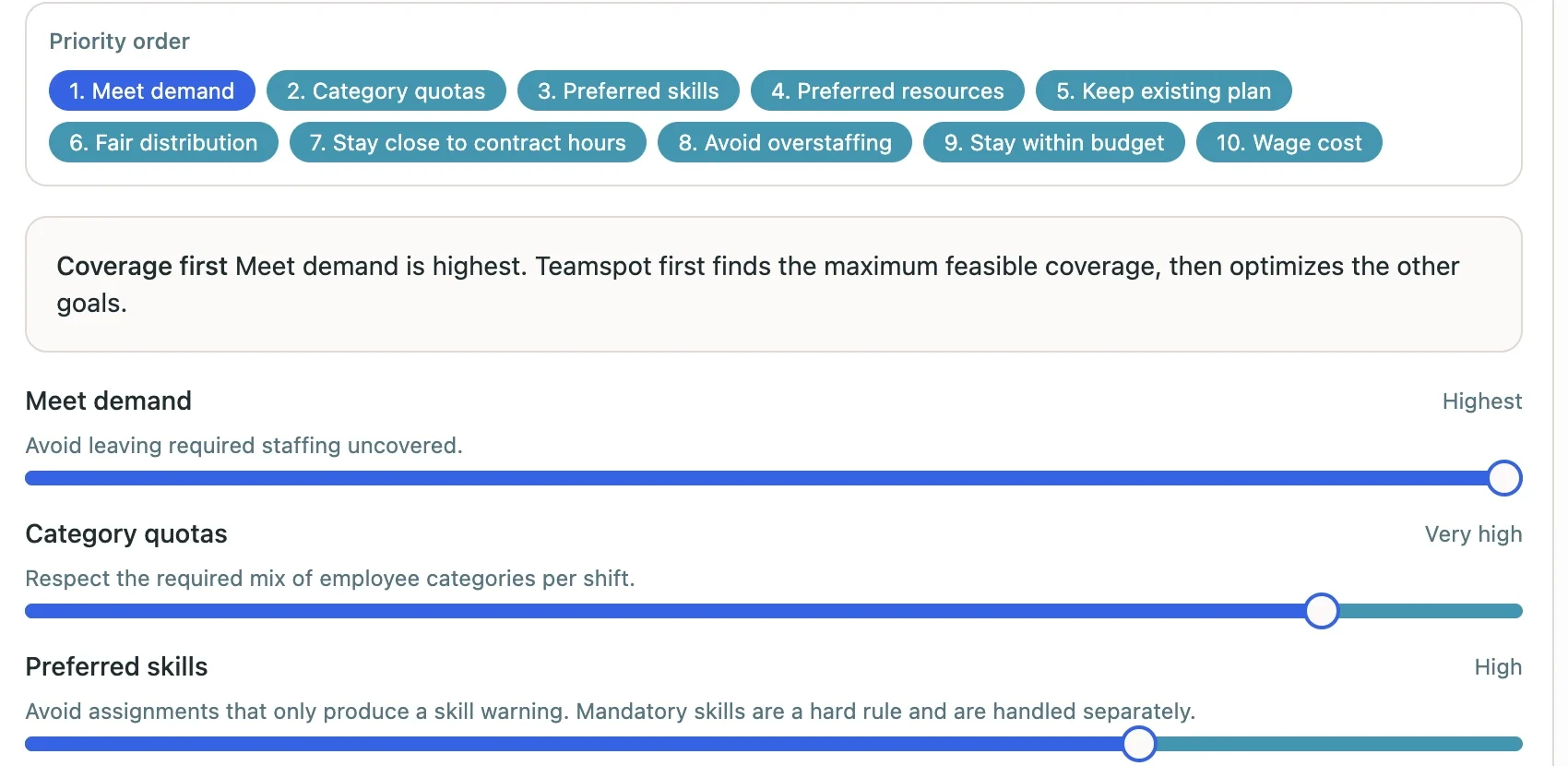
Teamspot proposes a schedule based on the staffing each shift needs and your priorities, such as skills, contract hours and a fair spread. Hard rules stay limits. If a shift cannot be filled within them, it stays open and you see that straight away.

You review the proposal before you apply it. Your team records hours worked in the app or on a time clock, and standard integrations pass them on to your HR and payroll software.

Read more about Teamspot's features and time tracking.

Teamspot scheduling priorities with sliders for staffing, categories and skills

Frequently asked questions about shift work

What is shift work?

In shift work, employees work set rotas at changing times. Teams take over from each other, so the work runs longer than one working day. Common forms in the Netherlands are the 2-, 3-, 4- and 5-shift systems.

What does ploegendienst mean?

Ploegendienst is the Dutch word for shift work. A 3-ploegendienst is a 3-shift system and a 5-ploegendienst is a 5-shift system. The allowance for it is called ploegentoeslag.

What is the difference between a 3-shift and a 5-shift system?

In a 3-shift system, an early, late and night team cover 24 hours on weekdays, and work usually stops at the weekend. In a 5-shift system, work runs 24 hours a day, 7 days a week. Three teams work while two are off.

How many hours do you work in a 5-shift system?

By rota, an average of 33.6 hours a week: 168 operating hours divided by five teams. Extra shifts, for example for training, come on top of that.

Is a shift allowance mandatory in the Netherlands?

The Working Hours Act does not require a shift allowance. Whether you pay one, and how much, follows from the CAO, the employment contract or a company scheme.

How many night shifts can someone work in a row?

If a run includes a night shift, it can be at most 7 shifts long, or 8 with a collective agreement. After three or more night shifts in a row, at least 46 hours of rest follow.

What does forward rotation mean?

In a forward-rotating rota, employees move from early to late to night shifts. Backward rotation goes the other way: night, late, early. Forward rotation is generally seen as healthier.

Does the works council have to agree to a shift system?

Yes. Introducing or changing a scheme for working and rest times needs the consent of the works council (Works Councils Act, article 27). This does not apply where the CAO already settles the matter in substance.
Plan your shifts without the puzzle

Tell us how your shifts run today. We'll show you how Teamspot proposes the rota and keeps track of the hours.

Our team gets back to you on working days.